

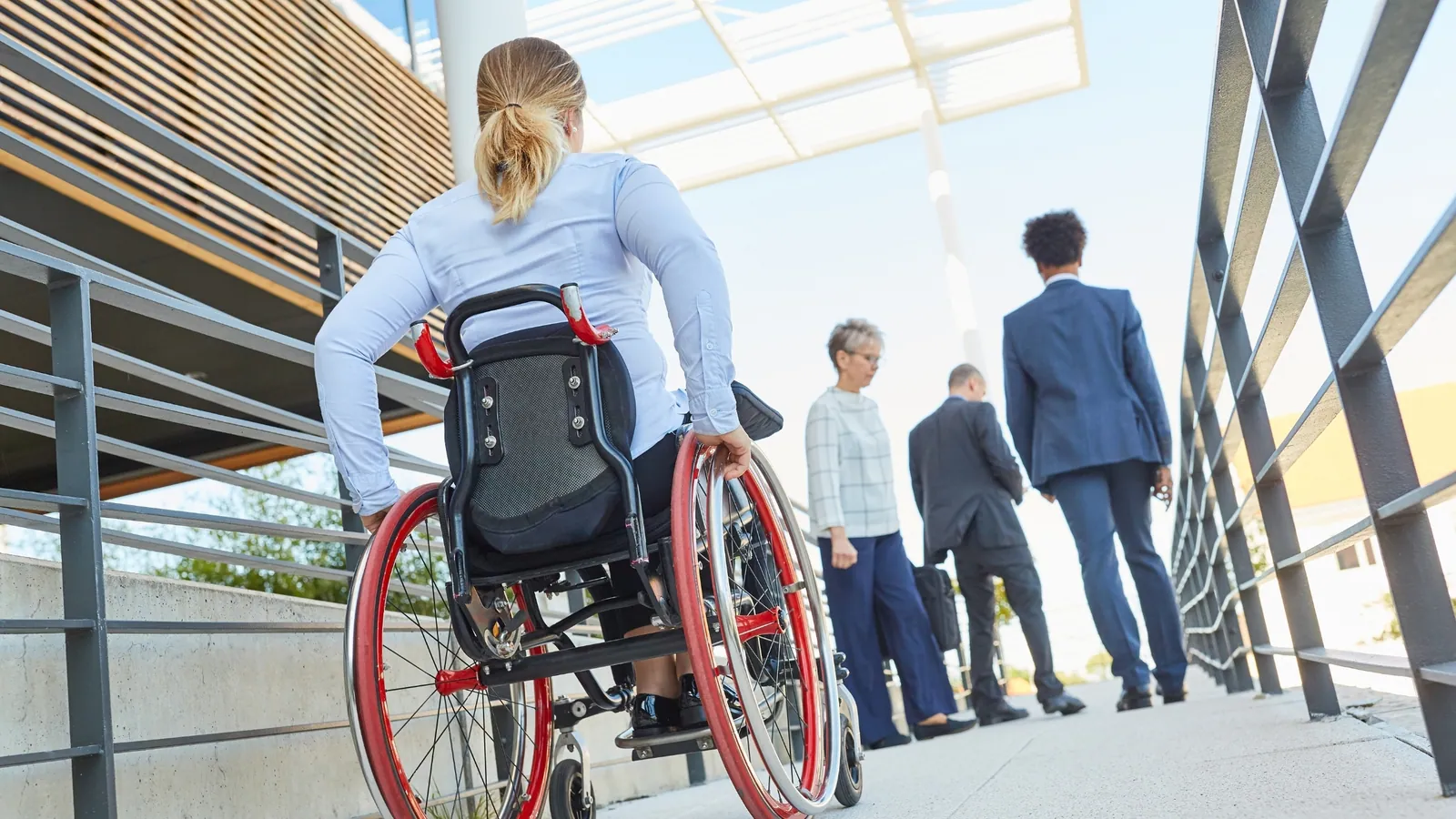
In France, since 20 April 2017 (in French), buildings open to the public have been required to provide access for people with reduced mobility (PRM), such as a second, sloped access route to make it easier for wheelchair users to enter. If your premises post-date this order, they will have one. The main entrance is therefore often perfectly suited to a person with reduced mobility, but it is once inside that problems can arise. Lifts are often adapted, but some equipment or rooms are not, leading to awkward situations that have to be dealt with urgently.
How to better adapt your buildings for people with reduced mobility
While external access to the building is regulated and compliant, the inside is another story. It is rare for everything to be ready for a person with reduced mobility (suitable chairs, height-adjustable desks, wide enough doorways…). More commonly, some equipment is in place, but it is poorly distributed or too limited for several people with reduced mobility to use it. However, the main difficulty remains a complete lack of equipment suited to people with reduced mobility.
Whatever the size or nature of your organisation, this is not inevitable: every company can adapt its premises, their access points and its meeting rooms and workspaces for people with reduced mobility. Here are some essential recommendations to make a real improvement to your spaces and enhance the quality of life and work of your visitors or employees with disabilities:
- Doors and ways of reaching upper floors (lifts, stairs…) designed so that people with reduced mobility can move around your premises easily.
- Better accessibility of your toilets for the personal comfort of people with reduced mobility on site.
- Ergonomic office furniture suitable for anyone with reduced mobility.
These few efforts will greatly help your employees or visitors with reduced mobility in their working lives, something that is still far too rare in the world of work in general (in French).
Managing your visitors with reduced mobility
Even when well prepared, your premises may sometimes require employees to help welcome visitors with reduced mobility, yet you rarely have a member of staff who is available and dedicated exclusively to this task. This is why your reception and visitor management software must take this into account so that you can welcome your guests as well as possible. With Hamilton Visitor, several statuses can be specified when pre-registering or registering a visit:
- VIP, to distinguish and prioritise certain important visitors over others who may be less urgent.
- Access to the site’s Wi-Fi code for a maintenance technician, a partner attending an in-person meeting, or in other practical cases.
- Reduced mobility, to let the receptionists know that the visitor must be accompanied and that the appropriate equipment will need to be brought out if there is not enough available on the premises.
To welcome a visitor properly, it is essential to prepare for their arrival. This means your employees must clearly indicate the specific features of each visit according to the visitor. If the reception team is well informed, it will know how best to welcome them.
Why your visitors need a complete welcome
Access to your building is the first part of your company that your visitors will discover. If it is not suited to visitors with reduced mobility, their experience risks getting off to a bad start. Not to mention that if the entrance is not equipped, what will the inside of your premises be like? In addition to complying with the regulations in this area, it is therefore necessary to adapt your building access and your interior spaces to give a good image of your company.
These decisions can prove costly, but they are long-term actions and, above all, a genuine mark of respect and inclusiveness for your company. Moreover, if your budget does not allow a complete overhaul of your equipment for employees or visitors with reduced mobility, a few targeted investments (equipping certain rooms, adding ways of reaching upper floors, etc.) can be a good start, which you will then need to make the most of with your reception team.
Hamilton Visitor can support your receptionists in this important task by providing, in addition to pre-registration, registration and ID document scanning features, an option attached to each visitor indicating that they have reduced mobility and that their welcome should be adapted so that the visit goes as smoothly as possible.
In short, your visitor reception solution must be smart and comprehensive so that the reception team has all the tools it needs to provide a suitable welcome, whether for people with reduced mobility or for other specific requests.
Conclusion
It is worth remembering that, while access to buildings for visitors with reduced mobility is a legal obligation, suitable interior fit-out should in no way be seen as optional. Equipping your premises with tools that make it easier for people with reduced mobility to move around and work, while preparing for their welcome, is essential. Solutions such as Visitor address this challenge: they support your teams in managing the flow of visitors and allow each visit to be annotated by category (VIP, reduced mobility, etc.) to optimise organisation and welcome. Modernising your reception set-up means both digitalising it and adapting it to receive all your employees and visitors. Ultimately, modernising reception means guaranteeing everyone (visitors and employees alike) an experience that is smooth, inclusive and respectful of everyone’s needs.