

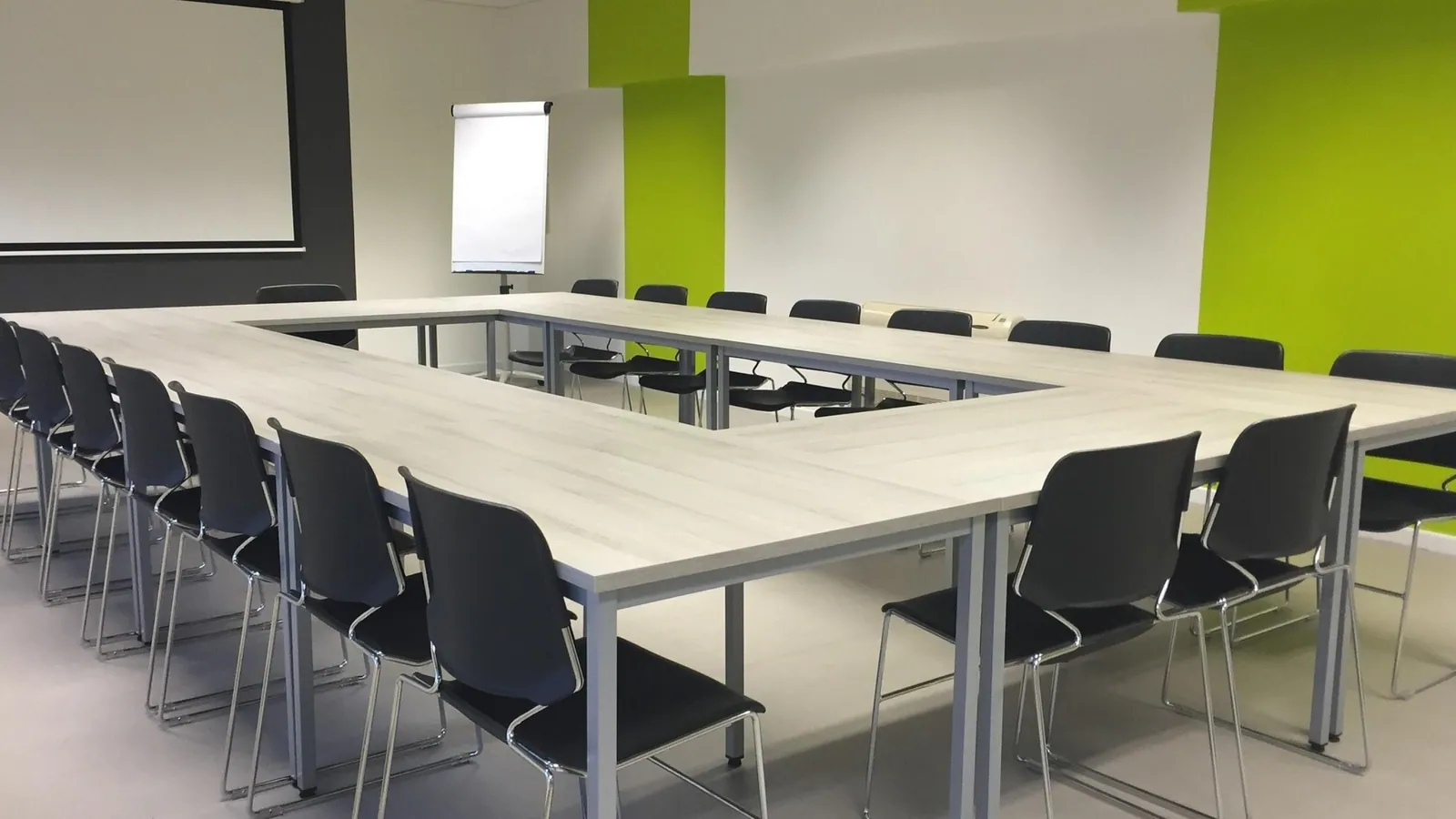
The current trend is clearly towards smaller workplaces, for environmental and economic reasons, and flexible office working is taking hold both for employee wellbeing and as a logical consequence of that trend. Yet one shortage is being felt more and more: the lack of available meeting rooms when employees are in the office.
Meeting rooms: a coveted and increasingly scarce resource
The meeting room is an indispensable resource. On top of this problem, some users could benefit from advice on how to make better use of it. Sometimes they are unaware of the problems they can cause, such as the ghost booking 👻: amusing for the uninitiated, but frustrating for those who suffer the consequences and see their working day disrupted.
Your meeting rooms end up blocked by empty bookings that nobody dares to use for fear of disturbing a possible latecomer.
Without realising it, you fall into the trap set by a forward-planning user who decided, often months in advance, that this meeting room would be theirs every morning on the same day of the week, for almost a year. A serious mistake since, as you know better than we do, nobody’s schedule is ever fixed and all sorts of unexpected events find their way into everyone’s bookings. There you have it: the root of the evil that is the ghost booking.
Effective tools for booking meeting rooms
To tackle this kind of problem faced by your employees, there are many meeting room management tools on the market; the challenge is finding the right one. Some tools are simply not designed for the purpose and are really just substitutes: easy to set up, but not compliant with the GDPR. Your employees’ privacy is not guaranteed, and some solutions do not even provide new features or regular maintenance.
Hamilton Meeting, on the other hand, is an intelligent, fully developed meeting room booking system whose main purpose is managing meeting room bookings. Since it came onto the market, the tool has evolved and has responded to customer requests on many occasions:
- Compliant with the GDPR
- Intelligent and flexible
- Customisable to suit each organisation’s technical environment.
Meeting room management software should be exactly that, not an Excel spreadsheet or a clever workaround using an app that was not necessarily designed for the job.
Indeed, this kind of meeting room booking tool should never be taken lightly or treated as an add-on. These tools are essential for organising your employees’ work properly and are often specialised for the very task you want to entrust to them. Choosing the wrong tool would be detrimental, both in day-to-day use and in how the tool evolves to meet your requests. A management problem, a hiccup, a feature you find missing: a serious, suitable tool will receive, process and handle them all. Take ghost rooms as an example. It is a feature our customers appreciate.
Banish the evil spirits haunting your meeting rooms!
Empty meeting rooms affect organisations in many ways, but it very often starts with a drop in productivity: with no free room, there is no meeting, and projects drag on. Then comes employee dissatisfaction. Employees know the room is rarely occupied yet always booked, and unfortunately all of this affects your efficiency without anyone being able to point to a serious, specific cause, because a badly booked room simply does not look professional.
Understanding quotas and working with them
A quota is a limit placed on each employee for booking the same room over a given period, to prevent booking abuse.
To solve this problem, Hamilton Meeting has introduced a number of innovative features, the most recent of which is a booking quota for a single meeting room for your employees. Thanks to this, there will be no more “forward-planning” colleagues imposing their schedules for three months or more on a meeting room your employees need for their work. For example, an employee can only book the New York room three times a week, to prevent any abuse.
These quotas may seem like a blessing to some and a punishment to others. Their existence helps the former, but must not penalise the latter. They are introduced solely so that one person’s work is not hampered by another’s. The tools in place help with this, but above all the organisation itself must succeed in making its employees understand that booking meeting rooms through an app is an integral part of working life.
Oversights and last-minute changes of plan are common in professional life, and out of respect for others they should be communicated to the rest of your colleagues. Booking the same room every week for three months is convenient, but the activity must be monitored so that other employees can book it if the original booker cannot attend. As with everything, a degree of social intelligence is needed for the machine to run smoothly.
Conclusion: booking quotas are essential for meeting room management
If your meeting room resources are running short, are becoming scarce, or if you are looking for greater efficiency, do not hesitate. Contact meeting room management professionals who can help you with this complex but essential task.
Introducing new processes will quickly become an asset for you. The features added over time, thanks to the experience gained together, will meet your employees’ expectations and improve both their satisfaction and their productivity. The meeting room is a raw and increasingly scarce resource: do not hesitate to protect it with optimisation tools such as booking quotas for your employees.