

The surge in organisations’ adoption of information and communication technologies, combined with the arrival of a new generation of workers on the job market, has profoundly transformed the workplace. This digital transition and the many tools that have come with it have made it possible to optimise the organisation of work, boost productivity and also increase flexibility.
At the same time, according to a study by CBRE (1), nearly a third of millennials are prepared to sacrifice other benefits, such as commuting time or prestige, in favour of a better working environment.
While their priorities include catering areas, relaxation spaces and employee services, the two themes we want to discuss in this article should not be overlooked. Whether it is on-site access control and visitor management or meeting room management, innovation is serving wellbeing in your workspaces.
Access control and visitor management
To ensure your employees’ wellbeing, it is essential to guarantee their safety and security. To do so, physical access control (airlocks, barriers or PNG gates, for example) is often used by organisations. For greater effectiveness, it is common practice to combine this equipment with a visitor management solution. This protects your site against intrusions and lets you control the flow of visitors with access to your building in real time. For the most sensitive sites, or for managers wishing to adopt comprehensive security, car park control and management can be included in the overall ecosystem.
Here again, the wealth of new technologies (biometric access readers, doors with badge readers, etc.) will reassure your employees on site, while ensuring smart management of your points of contact with the outside world.
A tip: choose your access management software by taking into account its range of features and how well it adapts to your environment.
Meeting room management and equipment
In every organisation, holding meetings is an essential part of collaboration. Whether it is an internal project meeting or a negotiation with clients, the way your rooms are equipped and laid out, as well as the organisational method you use, will constantly be judged by your employees and by your visitors.
Many workspace design policies in recent years have aimed to offer greater comfort to employees who use these rooms every day, with a view to creating a virtuous relationship between comfort and performance. However, the organisation and management of these spaces are all too often treated as a “bonus”. Yet using specialised software will solve many of the problems linked to operating these spaces, whatever the size of the estate or the number of users.
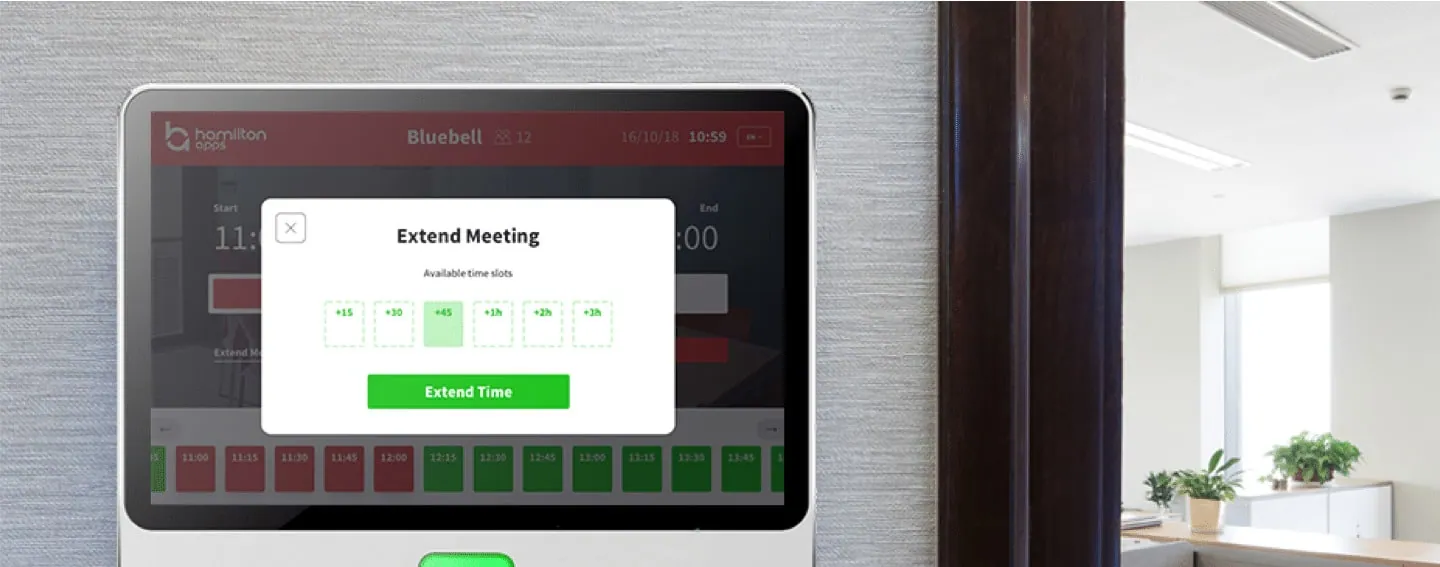
Such an application will, for example, give you the opportunity to prevent tensions between employees that can arise from double bookings or “ghost meetings” (rooms booked but left unoccupied). Finally, touchscreen booking tablets are also a major asset when it comes to flexibility and optimisation. They give very clear visibility of a room’s status from the corridor while adding a resolutely modern touch to your building.
(1) Source: Millennials: myths and realities, CBRE Research