Modern workplace: the desk booking app that makes data-driven decisions
There is one scene that neatly sums up what a smart building has become today. A meeting room stays empty all morning, the heating switches itself off, then the temperature gently rises back to 19°C just as someone pushes the door open. Nobody programmed anything that morning; the building simply knew that no one was there. That is exactly what a modern workplace should be: a space that adjusts before anyone even needs to ask.
In brief
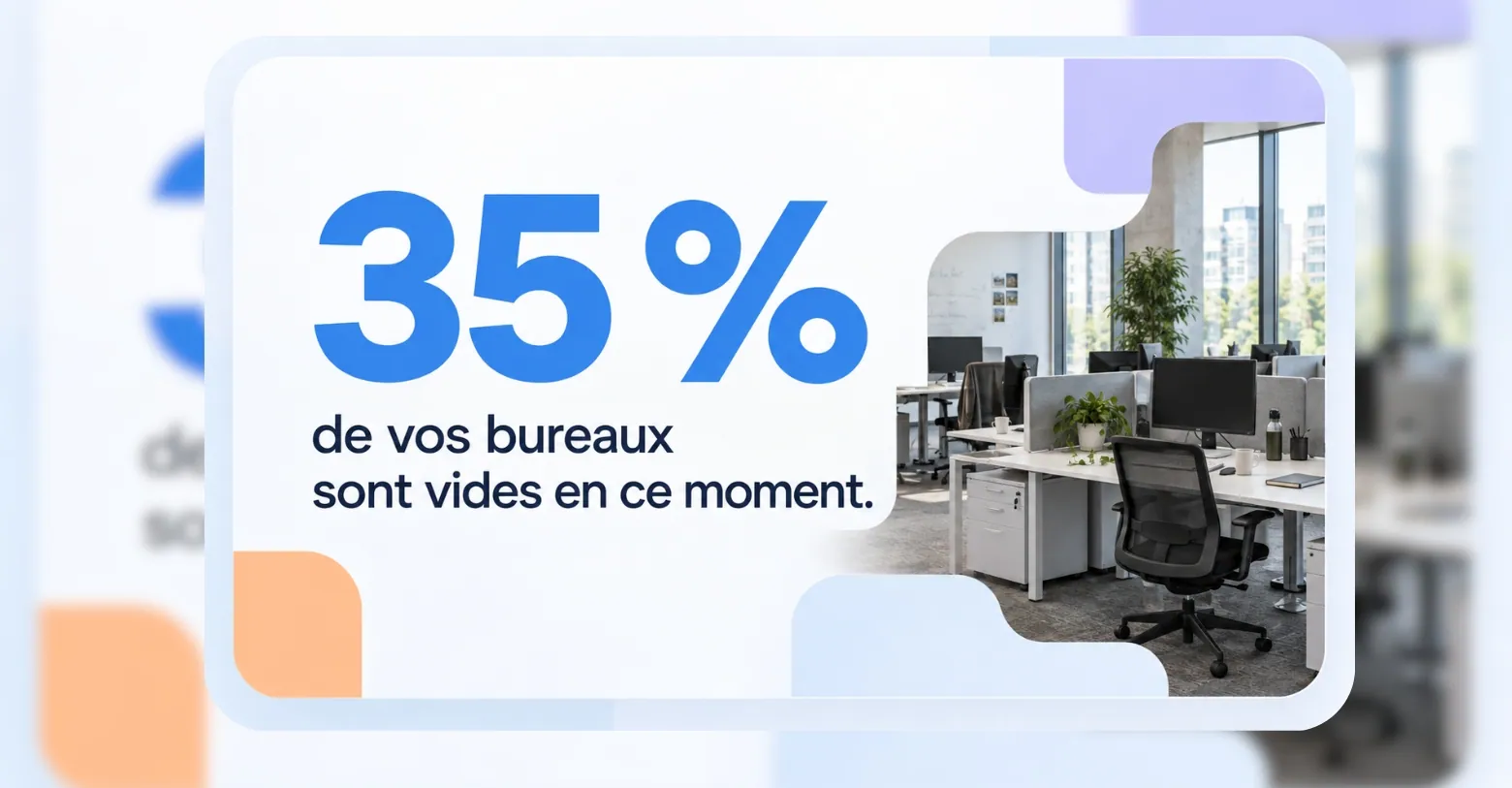
The actual occupancy rate of offices is around 35%, peaking at 63% on Tuesdays (Measuremen, 229,758 spaces analysed).
26% of hybrid employees in France practise coffee badging – declaring attendance without actually being present (Owl Labs, 2025).
54% of employees would resign if their employer abolished remote working (Bluedigo, 2025).
An unassigned desk saves €11,000 a year, according to the consultancy Asterès.
Temperature, the first sign of a modern workplace
This small heating adjustment is far from trivial. It avoids what ergonomists call cognitive friction: the minor irritation that forces someone to stop, look for something and adjust it before they can simply sit down and work. A modern workplace aims to remove these frictions one after another, often without anyone noticing.
Find your place at a glance with a desk booking app
Booking a desk follows the same logic. An employee who still has to look for a free desk on arrival, ask a colleague whether a table is taken, or discover that a room supposed to be available is in fact occupied, experiences exactly the kind of friction that automatic heating has removed from meeting rooms. Desk booking shows at a glance what is free, what is booked and which team members will be in that day.
Declared attendance that feeds data-driven decisions
What each employee declares when booking their day becomes, once it is all put together, material the organisation can use to understand how its spaces are really used. It is this shift – from an individual action to a collective view – that turns a simple desk booking app into a genuine tool for data-driven decisions.
What a desk booking app really changes day to day
A manager who sees that their team naturally comes together on Tuesdays and Thursdays can schedule team meetings on those two days, rather than imposing uniform attendance that nobody really follows.
A facilities manager who notices that an eight-person room hosts only three participants on average can split it into two smaller spaces that better suit how it is actually used. A corporate real estate team that compares the number of badge swipes in the morning with the number of desks actually occupied during the day eventually spots coffee badging: the moment when someone swipes in, has a coffee, chats briefly with a colleague, then goes back to work from home without anyone noticing at the time. Three different examples, one single source: attendance declared through the desk booking app, observed day after day.
Getting started with data-driven decisions without turning everything upside down
An occupancy rate measured on a single day says nothing about whether your offices are the right size. It needs to be tracked over time, taking into account holidays, average sickness absence and off-site business travel, which empty desks without the space being the wrong size. It is this view over time, not a snapshot at a given moment, that allows you to adjust your flexible office without getting it wrong.
Roll out a desk booking app to capture bookings and teams’ actual attendance.
Track the data over several months to smooth out holidays, sickness absence and business travel.
Compare these figures with the target occupancy rate the organisation has set.
Adjust the number of available desks first, before changing the overall office floor area.
Repeat this review every quarter, rather than relying on a single isolated observation.
A figure measured only once is never enough to make a decision; it is tracking over time that makes data-driven decisions reliable for optimising your flexible office.
A modern workplace built together with IT teams
None of this works without the systems running behind the scenes: the corporate calendar, the directory, the sensors that detect presence in a room. The workplace function gives this data meaning for teams, while the IT department ensures that the same data remains reliable, secure and well integrated with existing tools. Hamilton Apps builds its desk booking app with both these requirements in mind, so that a modern workplace is also a robust technical system.
Prepare your hybrid organisation
Let’s talk about how your teams work and the spaces available.